10 Feb

The Martingale strategy is one of the most well-known trading techniques, often attracting traders with its simple yet powerful approach to recovering losses and making consistent gains. However, despite its appeal, many traders are unsure of how to use it effectively or whether it can truly generate long-term profits.
Best Martingale Strategy for Trading
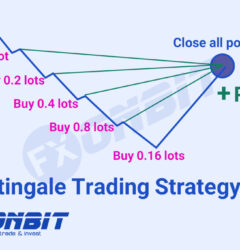
The Martingale strategy involves doubling your position size after a losing trade, with the goal of recovering all previous losses once a winning trade occurs. While it can be highly profitable during favorable market conditions, it is high-risk due to the potential for large drawdowns.
Read more: Mastering the Martingale Trading Strategy

If you want a refined and safer approach to the Martingale strategy, here’s how you can implement it effectively:
1. Use a Modified Martingale Approach (Safer Version)
- Instead of doubling after each loss, consider using a half-step approach to reduce drawdowns. For example:
- If you lose $10, increase the next trade to 1.5x instead of 2x the previous size. This reduces the potential for rapid account depletion.
- Example: $10 → $15 → $22.5 (instead of $10 → $20 → $40).
Explore more: Risk Management in Trading: A Complete Guide for Traders
2. Incorporate Technical Indicators for Entries
Instead of blindly opening trades, use indicators to confirm entries:
- Fibonacci Retracement: Enter at key retracement levels (e.g., 38.2%, 50%, 61.8%) where the price is likely to reverse.
- Supertrend: Avoid placing Martingale trades when a strong trend is active.
- RSI or MACD: Wait for overbought/oversold signals to trigger a better reversal opportunity.
3. Set Stop Losses and Maximum Drawdown Limits
Never rely solely on account balance to decide when to stop:
- Set a maximum drawdown limit (e.g., 20%-25% of total equity).
- Implement stop losses on each Martingale trade to protect against major reversals.
- Anti-Martingale Approach: Instead of doubling after losses, consider doubling after a win in trending markets for compounding profits with lower risk.
Read more: What is Scalp Crypto Trading
4. Hedge with Complementary Strategies
Incorporate hedging alongside Martingale:
- Open buy and sell positions simultaneously but only let one side scale using the Martingale approach.
- Use options or futures contracts to limit your losses in case the market moves against you.
5. Choose the Right Market and Timeframe
- Best Markets: Gold (XAUUSD), EURUSD, and major currency pairs with medium volatility.
- Avoid: Extremely volatile assets like cryptocurrencies, unless you’re using small lot sizes.
- Timeframe: Consider 15M, 30M, or 1H charts for shorter-term movements that allow for quicker recoveries.
6. Combine Martingale with Fibonacci Levels
One effective hybrid strategy is to enter Martingale trades only when the price is between key Fibonacci levels (e.g., 61.8% and 78.6% retracement). This gives you better odds of price reversals.
- Entry 1: Buy/Sell when price hits the 61.8% retracement.
- Entry 2: Double (or 1.5x) position at the 78.6% retracement.
- Entry 3: Place the final position if price nears 88.6% or a key support/resistance zone.
Explore more: Best Forex Screeners for Day Trading
7. Use Risk-Adjusted Lot Sizes
- Don’t start with large lots. For example, if your balance is $1,000, start with micro-lots (0.01) or 0.1 lots for higher balances to give your account room for multiple trades.
8. Backtest Before Live Trading
Backtest your strategy using tools available on platforms like FXonbit before implementation to see if it meets your risk tolerance.
Read more: Best Crypto Screener for Trading
Example of a Safer Martingale Trade Flow
| Trade # | Entry Condition | Lot Size | Stop Loss | Target | Net Result |
|---|---|---|---|---|---|
| 1 | RSI oversold (Buy) | 0.01 | 30 pips | 50 pips | +$5 |
| 2 | Price retraces 38.2% | 0.015 | 30 pips | 50 pips | +$7.5 |
| 3 | Price retraces 61.8% | 0.02 | 30 pips | 50 pips | +$10 |
Read more: Crypto Scalp Trading: Basic Guide
Tips for Long-Term Success
- Avoid emotional trading. Martingale can be tempting during long losing streaks, so follow your predefined rules strictly.
- Monitor the market conditions. Trending markets and ranging markets affect Martingale’s success differently.
- Keep a trading journal to log your wins/losses and evaluate your performance.
This strategy, when combined with proper risk management, technical indicators, and backtesting, can help reduce the high risks associated with traditional Martingale systems.
Explore more: Crypto Grid Trading Strategy Ultimate Guide for Profitable Market Trading

Does the Martingale Strategy Work in Trading?
Yes, the Martingale strategy can work in trading, but only under certain conditions and with strict risk management. The concept is simple: after each losing trade, you double your position size, so that when a winning trade eventually occurs, it recovers all prior losses and generates a small profit. While the strategy can work under certain conditions, it’s not a one-size-fits-all approach. Let me expand a bit on the factors that determine its success:
1. Capital Reserves: Why It’s Critical
- Challenge: Martingale requires doubling position sizes after each loss. If the losing streak continues, the required capital grows exponentially.
- Example: Starting with $10 and losing 5 consecutive trades → you’d need $320 for the next trade to continue.
- Solution: Only use Martingale if you have:
- Adequate capital: At least 10-15x the initial lot size.
- Small initial trades: Start with micro-lots to reduce risk, especially in markets like forex and crypto.
2. Market Conditions: Finding Reversal-Friendly Environments
- Effective Markets: Ranging or oscillating markets, where prices frequently reverse, are ideal.
- Good markets: Major currency pairs (EUR/USD), Gold (XAU/USD), or markets with predictable patterns.
- Bad markets: Highly volatile or trending assets like cryptocurrencies (BTC, ETH) during major market events.
- Improved Strategy: Combine Martingale with indicators like:
- RSI or Stochastic Oscillator for overbought/oversold signals.
- Bollinger Bands to detect price reversals.
3. Risk Management: The Lifesaver
- Without proper risk management, Martingale is a recipe for disaster. Even with frequent reversals, prolonged streaks of losses are inevitable. Here’s how to mitigate that:
- Set a Maximum Drawdown Limit: Example: Don’t risk more than 20-25% of your account balance.
- Limit the Number of Doubling Trades: If you reach 3-4 consecutive losses, stop and reassess.
- Anti-Martingale Variation: Instead of doubling after a loss, double after a win in trending markets for safer profit growth.
4. Probability vs. Reality
- The Assumption: Martingale relies on the theory that a win is eventually inevitable.
- The Problem: In practice, markets can trend longer than expected, wiping out accounts before the winning trade arrives.
- Solution: Combine Martingale with:
- Technical analysis to improve entry accuracy.
- Hedging to offset risk if the market keeps moving against you.
Example: Calculating Risk
Let’s say you start with a $1,000 account and an initial trade of $10:
| Trade # | Trade Amount | Cumulative Loss |
|---|---|---|
| 1 | $10 | -$10 |
| 2 | $20 | -$30 |
| 3 | $40 | -$70 |
| 4 | $80 | -$150 |
| 5 | $160 | -$310 |
Without sufficient capital or a winning trade soon, the losses can snowball fast. That’s why a well-defined stop-loss strategy and risk management rules are vital.
When Does Martingale Work Best?
- When paired with scalping strategies in short timeframes (1M, 5M, 15M).
- In range-bound markets with frequent oscillations.
- With small position sizes and a plan to exit at predefined levels.
When to Avoid Martingale:
- Trending markets with strong momentum.
- During news events or high market volatility (NFP, FOMC, etc.).
- If you have limited capital or a low risk tolerance.
Verdict: Can It Work Long-Term?
Yes, the Martingale strategy can work, but it is not sustainable without modifications. Success lies in:
- Starting small and scaling carefully.
- Combining Martingale with indicators to improve winning chances.
- Setting clear exit rules before risking too much.
A hybrid or modified Martingale approach (such as the anti-Martingale) often proves more reliable in the long term.
However, the strategy’s success largely depends on:
- Having sufficient capital: Without a large reserve of capital, traders risk running out of funds during prolonged losing streaks.
- Trading in markets with frequent price reversals: The Martingale strategy is most effective in markets where reversals are common.
- Managing risk carefully: Without proper limits, the strategy can lead to significant losses.
Explore more: What is Crypto Screener? The Best Crypto Screener

What Is the 100% Profitable Martingale Strategy?
There is no 100% guaranteed profitable Martingale strategy, and any claims suggesting otherwise should be approached with caution. The Martingale strategy relies on the assumption that a winning trade will eventually occur, but in real-world trading, markets can trend against a position for extended periods.
While no strategy is completely foolproof, you can increase your chances of success by:
- Starting with small initial positions to allow room for multiple doubling sequences.
- Setting a maximum loss limit to prevent runaway losses.
- Using technical indicators to improve the timing of entries.
Remember, the key is not to rely solely on Martingale but to integrate it with sound risk management and market analysis.
The truth is, no strategy, including Martingale, guarantees 100% profitability. However, traders have developed “enhanced Martingale approaches” to improve the odds of success while reducing risks.
Let’s break down what a highly optimized version of Martingale might look like:
Why No 100% Profitable Martingale Strategy Exists
- The Core Issue: Martingale assumes that a winning trade will eventually happen, but prolonged market trends can lead to significant losses and wiped-out accounts before recovery occurs.
- Reality: There are no guarantees in financial markets. A strong trend can last for days, weeks, or even months without reversal.
However, you can increase profitability and reduce risks with the following enhancements:
Enhanced Martingale Strategy Components
1. Start with Small Initial Positions
- This is critical to give you room to double your position multiple times without risking your entire account.
- Example: If your balance is $1,000, start with 0.01 lots or $1 positions.
- As a rule of thumb, ensure your starting position size is less than 1% of your account balance.
2. Limit the Doubling Sequence
- Don’t allow endless doubling of trades. Set a maximum of 3-5 levels before cutting losses or exiting.
- Example Sequence: $10 → $20 → $40 → $80 → STOP.
- If the trend continues after 5 losses, it’s safer to stop and reassess rather than continuing to double indefinitely.
3. Use Technical Indicators for Entry and Exit
Martingale can work better when you’re not blindly entering trades. Improve timing with:
- RSI (Relative Strength Index): Only enter trades when RSI indicates oversold or overbought conditions.
- Bollinger Bands: Place trades when price touches the bands and shows signs of reversal.
- Moving Averages (MA): Trade with short-term reversals in markets that temporarily retrace toward the MA.
4. Set a Stop Loss and Take Profit
While Martingale seeks to recover losses by doubling, you must protect against runaway losses:
- Stop Loss: Set it below your maximum drawdown limit (e.g., 20%-25% of your capital).
- Take Profit: Secure profits early instead of waiting for a full recovery.
5. Consider the Anti-Martingale Approach
Instead of doubling after losses, double after wins when trading in a strong trend. This protects you from runaway losses while allowing compounding gains.
Example of Anti-Martingale Flow:
- Start with $10 on a winning trade.
- If the trade wins, double to $20.
- Continue doubling while in profit, but reset after a loss.
6. Pair Martingale with a Hedging Strategy
One approach to protect against large losses is to hedge positions:
- Open opposite trades at certain levels.
- If the main trade keeps losing, the hedge can offset losses.
- This is common in forex and gold trading.
Read more: FXonbit CandleStick Pattern Finder Service: Your Gateway to Smarter Forex and Crypto Trading

Example of an Enhanced Martingale Strategy
Let’s say you are trading EUR/USD with an initial balance of $1,000:
- Start with 0.01 lot size.
- Enter the first trade only when the price hits oversold conditions (RSI < 30).
- Double the lot size if the trade is a loss:
- 0.01 → 0.02 → 0.04 → 0.08.
- Exit after 3-4 doubling levels, or if the market trends beyond the maximum loss limit.
Potential Issues to Avoid
- Over-leveraging: If you start with too large of a position, the strategy will fail quickly.
- Trending markets: If you trade during strong trends (without pullbacks), Martingale becomes risky.
- Ignoring drawdown limits: Always stick to a maximum drawdown limit to avoid account wipeout.
- No 100% profitable Martingale strategy exists, but with small positions, technical indicators, and strict risk management, you can reduce the risks significantly.
- Don’t rely solely on Martingale. It should be part of a broader strategy that includes technical analysis, stop losses, and alternative techniques like Anti-Martingale or hedging.
What Is the Best Martingale Strategy for Trading?
The “best” Martingale strategy depends on how you manage risk and combine it with other trading methods. Here are key components to optimize the strategy:
- Start small: Choose an initial trade size that is a small percentage of your total capital (e.g., 1-2%).
- Limit the number of doubling attempts: Don’t double indefinitely—set a maximum number of attempts to protect your capital.
- Combine with technical indicators: Use tools like RSI (Relative Strength Index), MACD, or moving averages to identify optimal entry points and potential reversals.
- Consider Anti-Martingale variants: Instead of doubling after losses, some traders increase position sizes after wins and reduce them after losses to manage risk better.
How Profitable Is the Martingale Strategy?
The profitability of the Martingale strategy depends on:
- Market conditions: In volatile markets with frequent reversals, the strategy can be more profitable.
- Capital availability: Traders with large capital reserves have a better chance of recovering losses.
- Risk management: Without proper risk controls, the strategy can lead to large drawdowns and potential losses.
In general, the strategy can generate small but consistent profits in the short term. However, long-term profitability is not guaranteed, especially in markets with prolonged trends.
Factors Affecting the Profitability of Martingale
1. Market Conditions: The Right Environment Is Key
- When it works: Martingale performs best in range-bound or reversal-prone markets where prices oscillate within predictable support and resistance levels.
- Example: Major forex pairs (like EUR/USD) during low volatility periods.
- Gold (XAU/USD): Known for reversals after retracements, especially during quiet trading sessions.
- When it fails: The strategy struggles in strong trending markets without pullbacks. For example, during news events or large market moves, it can lead to consecutive losses.
- Example: Crypto markets (BTC/ETH) during major rallies or crashes.
2. Capital Availability: Sufficient Reserves Reduce Risk
- The larger the capital reserve, the higher the probability of recovering losses.
- Why: Martingale’s doubling mechanism is exponential, so traders with limited funds risk running out of capital before a winning trade occurs.
- Trade 1: $10 → Loss
- Trade 2: $20 → Loss
- Trade 3: $40 → Loss
- Trade 4: $80 → Loss
After just 4 losing trades, you’ve already risked $150.
3. Risk Management: Limiting Losses Is Critical
- Without proper risk management, Martingale can lead to massive drawdowns. But with stop losses and maximum doubling limits, you can avoid wiping out your account.Key Risk Controls:
- Maximum Doubling Limit: Limit the number of doubling trades to 3-5 to prevent exponential losses.
- Maximum Drawdown Limit: Set a limit on losses (e.g., 20%-25% of the account balance).
- Hedging or Anti-Martingale: To offset risks, hedge trades or only double after wins.
Profitability Expectations: Short-Term vs. Long-Term
Short-Term Profitability
- Why it works short term: In many cases, prices do reverse after a series of losses, allowing traders to recover losses and gain small profits.
- Profit Potential: Small, consistent profits with high win rates (e.g., 90%+ if the market frequently reverses).Example:
- Start with $10, double after each loss, and gain $10 when a win occurs.
- If you win 9 out of 10 trades, you’ll likely make small, steady profits.
Long-Term Profitability: The Risks
- In the long term, the Martingale strategy is not guaranteed to be profitable because:
- Losses are exponential: A long losing streak can result in catastrophic losses.
- Markets can trend longer than expected: If no reversal occurs, the strategy fails.
- A 6-trade losing streak with a $10 initial trade would require $630 on the next trade to recover losses.
Read More: Trading Chart Patterns: What Are Chart Patterns? + PDF
Profitability Calculation Example
Let’s assume:
- Initial balance: $5,000
- Initial trade size: $10
- Target profit per winning trade: $10
| Trade # | Trade Amount | Result (Win/Loss) | Cumulative Profit/Loss |
|---|---|---|---|
| 1 | $10 | Loss | -$10 |
| 2 | $20 | Loss | -$30 |
| 3 | $40 | Loss | -$70 |
| 4 | $80 | Win | +$10 |
| Net Profit: | $10 |
Although the win recovered all losses, the risk involved ($150 exposure) is much larger than the small $10 profit. Over time, prolonged losing streaks can wipe out several previous wins.
Optimizing the Strategy for Profitability
To increase the chances of profitability:
- Start with small positions: Micro-lots (0.01) or 1% of account balance.
- Set strict stop losses and limits: Don’t allow unlimited doubling.
- Trade only during low volatility or range-bound conditions.
- Consider the Anti-Martingale approach in trending markets.
Summary: Is Martingale Profitable?
| Timeframe | Profitability | Why |
|---|---|---|
| Short term | Profitable (with small, consistent gains) | Small profits as long as reversals happen quickly. |
| Long term | Risky and potentially unprofitable | Long losing streaks and exponential losses can wipe out gains. |
| Best markets | Ranging or low-volatility markets | Reversals are more common. |
| Worst markets | Strong trending or volatile markets | Prolonged trends lead to large drawdowns. |
Final Verdict:
Martingale can be profitable in the short term, but long-term success is unlikely without strict risk management. For better results, consider combining it with hedging, technical indicators, or the Anti-Martingale approach to improve your odds of profitability.
Read more: How to Customize Crypto Screener to Match Your Trading Strategy
What Is an Example of a Martingale?
Let’s consider a simple example using a starting position of $100:
| Trade | Position Size | Result | Cumulative Loss | Net Profit |
|---|---|---|---|---|
| Trade 1 | $100 | Loss | -$100 | -$100 |
| Trade 2 | $200 | Loss | -$300 (-100 – 200) | -$300 |
| Trade 3 | $400 | Loss | -$700 (-300 – 400) | -$700 |
| Trade 4 | $800 | Win | +$800 | +$100 |
In this example, the fourth trade recovers all previous losses and generates a net profit of $100.
Read more: What is Crypto Whale Tracker? How FXonbit Empowers You to Follow Market Giants

When Should You Use a Martingale?
The Martingale strategy is best used under the following conditions:
- Markets with frequent price reversals: Ideal markets include forex pairs, gold, and cryptocurrencies.
- Ample capital reserves: Ensure you have enough funds to sustain multiple doubling rounds.
- Clear risk management rules: Define exit points and maximum loss limits.
Avoid using Martingale during periods of high market uncertainty or when strong trends dominate.
Best Conditions to Use the Martingale Strategy
1. Markets with Frequent Price Reversals or Ranges
- Why: Reversals provide the opportunity to recover losses and take profits after multiple trades.
- Ideal markets:
- Forex pairs (EUR/USD, GBP/USD): Major pairs with high liquidity tend to range or retrace frequently.
- Gold (XAU/USD): Known for oscillations, especially during quiet trading hours.
- Some cryptocurrencies (BTC/USDT, ETH/USDT): In low-volatility periods, certain crypto pairs show predictable retracements.
Tip: Use technical indicators like Bollinger Bands or RSI to spot potential reversal points.
Explore more: Symmetrical Triangle Pattern: A Powerful Price Action Signal
2. When You Have Ample Capital Reserves
- Why: The Martingale strategy requires exponential increases in position size after losses. Without enough capital, you risk a margin call or complete account depletion.
How to calculate if you have enough capital:
Let’s assume you start with $10 as the initial trade and double after every loss.
| Trade # | Amount | Cumulative Exposure |
|---|---|---|
| 1 | $10 | $10 |
| 2 | $20 | $30 |
| 3 | $40 | $70 |
| 4 | $80 | $150 |
| 5 | $160 | $310 |
Recommendation:
- Use micro-lots or small positions (e.g., 0.01 lots) to allow room for multiple trades.
- Have at least 10-15x the starting capital to survive possible losing streaks.
3. When You Have Clear Risk Management in Place
- Why: Without risk management, Martingale can lead to catastrophic losses.
- Key rules for success:
- Set a maximum doubling limit: For example, stop after 3-5 losing trades and cut your losses.
- Define a maximum drawdown: Don’t risk more than 20%-25% of your total balance.
- Place stop losses on each trade: This prevents runaway losses from prolonged trends.
Example Risk Plan:
- Starting capital: $5,000
- Initial trade: $10
- Stop doubling after 4 trades (max loss exposure: ~$150)
- Exit positions if drawdown exceeds 20% of total capital (~$1,000)
4. When Volatility Is Low or Medium
- Why: High volatility leads to unpredictable market moves and extended losing streaks, making Martingale dangerous.
- When to avoid:
- During major economic events (NFP reports, FOMC meetings).
- In highly volatile markets like crypto during major news (e.g., regulatory announcements or Bitcoin halving events).
When to enter:
- Trade during sessions with less news impact or when markets are consolidating.
- Use tools like the economic calendar to avoid high-volatility periods.
5. When Combined with Other Strategies or Indicators
- Why: Blindly entering trades is risky. Combining Martingale with other strategies improves timing and reduces risk.
Good indicators to pair with Martingale:
- Bollinger Bands: Enter when prices hit the upper or lower band, indicating possible reversals.
- RSI (Relative Strength Index): Enter trades when RSI signals oversold (<30) or overbought (>70) conditions.
- Fibonacci Retracement: Open positions at key retracement levels (38.2%, 50%, 61.8%).
When to Avoid Martingale
| Situation | Why to Avoid |
|---|---|
| High market volatility | Extended losing streaks are more common during market chaos or news events. |
| Strong, trending markets | Martingale relies on reversals, which may not occur in strong upward/downward trends. |
| Limited capital | Without enough capital, you risk running out of funds before a winning trade occurs. |
| No risk management | Unmanaged Martingale trades can lead to margin calls and catastrophic losses. |
Summary: When to Use Martingale
| Condition | Why It’s Important |
|---|---|
| Ranging or reversal-prone markets | Frequent reversals provide the opportunity to recover losses and make profits. |
| Adequate capital reserves | To survive losing streaks without depleting your account. |
| Clear risk management | Limits potential losses and prevents exponential drawdowns. |
| Low to medium volatility | Prevents extreme market swings from wiping out trades. |
| Technical confirmation | Improves the probability of successful reversals. |
Read Related: 40 Powerful Candlestick Patterns in Forex & Crypto
What Is the Martingale Rule?
The core rule of the Martingale strategy is simple:
- Start with an initial trade size.
- If the trade results in a loss, double the position size for the next trade.
- Continue doubling until a winning trade occurs.
- Once a winning trade is achieved, reset to the original trade size.
The goal is to recover all previous losses and secure a small profit with each win.

What Is the Advantage of a Martingale?
- Loss recovery: The strategy ensures that any winning trade will recover all prior losses and generate a net profit.
- Simplicity: Easy to understand and implement, especially for beginners.
- Consistent small gains: When executed correctly, the strategy can provide regular profits.
What Is Better Than Martingale?
While the Martingale strategy can be effective, there are alternative approaches that many traders consider safer and more profitable in the long term:
- Anti-Martingale strategy: Increase position sizes after wins and reduce them after losses to protect capital.
- Fixed position sizing: Maintain consistent trade sizes to avoid exponential losses.
- Trend-following strategies: Use strategies that capitalize on strong market trends instead of relying on reversals.
- Risk-based strategies: Focus on risk-reward ratios and proper stop-loss placement to minimize drawdowns.
Can You Make a Living Off the Martingale Strategy?
Making a living using the Martingale strategy is extremely risky and generally not recommended. While short-term profits are possible, the strategy’s long-term sustainability is questionable due to the following risks:
- Capital depletion: A single prolonged losing streak can wipe out an entire account.
- Emotional stress: The pressure of doubling losses can lead to poor decision-making.
- Market unpredictability: Markets can stay irrational longer than a trader’s capital can sustain.
To make a living off trading, it’s better to diversify strategies, focus on risk management, and develop a well-rounded trading plan.
Why Making a Living Off Martingale Is Difficult
1. Capital Depletion: Exponential Losses
- Core Problem: The Martingale strategy’s doubling nature can lead to exponential losses if a prolonged losing streak occurs.
- Example: Starting with a $10 trade:
- $10 → $20 → $40 → $80 → $160
- After 5 losses, you’re already down $310. If the losing streak continues, losses quickly grow beyond most traders’ capital.
- Example: Starting with a $10 trade:
- Why it’s risky: Even if you have a large balance, a few unlucky streaks can wipe out months of profits.
- Fact: In financial markets, losing streaks of 5-10 trades aren’t uncommon.
Key takeaway: Without sufficient capital and strict limits, even traders with good starting positions face ruin during extended losing periods.
2. Emotional Stress and Decision Fatigue
- Psychological Pressure: Doubling the size of your position after each loss leads to significant emotional strain.
- Losing 3 or 4 trades in a row might already cause panic, and doubling the stakes on the next trade often leads to impulsive decisions or overtrading.
Example:
A trader starting with $100 might find themselves risking $1,000 after 4-5 losses—triggering emotional stress and irrational decision-making.
- Why it matters: Emotional mistakes often lead to breaking risk management rules, overtrading, or quitting the strategy altogether.
Solution: To avoid emotional burnout, successful traders use diversified strategies and maintain strict rules for risk control.
3. Market Unpredictability: Trends Can Last Longer Than Expected
- Core Problem: The Martingale strategy assumes that a reversal will eventually occur, but financial markets can stay irrational for long periods without a reversal.
Example:
- A trader using Martingale expects a currency pair like EUR/USD to reverse after falling 200 pips.
- However, strong market trends (like during economic news releases or geopolitical events) can extend beyond expectations, leading to a prolonged losing streak.
Key Risks:
- Trending markets (crypto, stock indices) are especially dangerous for Martingale traders.
- News events (interest rate announcements, inflation reports) can cause large, unpredictable price swings.
Alternative Approach: Combine Martingale with technical indicators to avoid trading during strong trends.
Can You Reduce Risks and Improve Profitability?
While you shouldn’t rely solely on Martingale to make a living, you can modify and combine it with other strategies to reduce risks and improve profitability.
1. Start with a Small Initial Position
- Why it helps: Small starting positions give you room for more doubling sequences, reducing the chances of hitting the maximum drawdown.
Example: If your balance is $5,000:
- Instead of starting with a $100 trade, start with $10 or $20.
2. Set a Maximum Doubling Limit
- Why: Limiting the number of doubling trades helps prevent catastrophic losses.
- How: Stop doubling after 3-5 losing trades, even if you haven’t recovered losses.
Example:
If you start with $10 and double up to 4 trades ($10 → $20 → $40 → $80), set a rule to stop if you reach a cumulative loss of $150.
3. Use Anti-Martingale (Double After Wins, Not Losses)
- Instead of doubling after each loss, double your position size after a winning trade.
- Why: This allows you to compound gains during winning streaks without increasing exposure to losses.
Example:
- Trade 1: Win $10 → Double next trade to $20
- Trade 2: Win $20 → Double next trade to $40
- Trade 3: Loss → Reset to $10
4. Diversify Strategies (Don’t Rely Solely on Martingale)
- Why: No single strategy, including Martingale, can consistently perform well across all market conditions.
- How: Combine Martingale with:
- Trend-following strategies for strong trending markets.
- Hedging or using options to protect against large losses.
- Scalping strategies to capture small profits without heavy exposure.
What Successful Traders Do Instead
Traders who make a living off trading generally:
- Use diversified trading plans: They combine multiple strategies like scalping, breakout trading, or swing trading.
- Focus on risk management: Limiting drawdowns to preserve capital is their priority.
- Don’t rely on “guaranteed recovery” strategies: They accept losses as part of trading and stick to stop losses and predefined risk limits.
Why Martingale Alone Isn’t a Sustainable Income Strategy
| Factor | Why It Fails Long-Term | Safer Alternatives |
|---|---|---|
| Exponential losses | Doubling losses leads to quick depletion of capital. | Limit doubling sequences and use small initial positions. |
| Emotional stress | Large losses create emotional strain, causing poor decisions. | Use Anti-Martingale and smaller lot sizes. |
| Market unpredictability | Markets can trend longer than expected, wiping out accounts. | Combine Martingale with technical indicators and trend strategies. |
| Lack of diversification | Relying solely on one strategy is risky in changing market conditions. | Combine Martingale with other trading methods. |
What Is a Safe Martingale Strategy?
A “safe” Martingale strategy aims to minimize risks while preserving its potential for recovery and profit. Here are some tips:
- Start with a small initial position size: Limit your exposure from the beginning.
- Set a maximum loss limit: Stop doubling after a predefined number of losses.
- Combine with technical analysis: Use indicators to improve entry timing.
- Use Anti-Martingale principles: Consider reducing positions after losses to limit drawdowns.
- Diversify your strategies: Don’t rely solely on Martingale; integrate it with other methods.
Key Elements of a Safe Martingale Strategy
1. Start with a Small Initial Position Size
- Why: This allows room for multiple doubling sequences without over-leveraging or wiping out your account.
- How: Limit the first trade to 0.5%-1% of your total account balance.
- Example: If your balance is $5,000, start with $25-$50.
Tip: Use micro-lots (0.01 lots) in forex or small initial positions in crypto.
2. Set a Maximum Loss Limit
- Why: Without a predefined stop point, exponential growth can cause devastating losses.
- How: Determine the maximum number of times you’ll double your position and define a maximum drawdown limit.
Example Plan:
- Maximum Doubling Steps: 3-5 trades (e.g., $10 → $20 → $40 → $80 → STOP)
- Maximum Drawdown: 20%-25% of the total balance.
Stop Doubling If:
- You hit 3-5 consecutive losses.
- Your drawdown exceeds the maximum limit.
3. Combine with Technical Analysis
- Why: Instead of entering trades randomly, use indicators to improve entry timing and increase the chance of reversals.
Effective Indicators to Use:
- RSI (Relative Strength Index): Enter when RSI signals overbought (>70) or oversold (<30) conditions.
- Bollinger Bands: Trade when prices touch the upper or lower band and show signs of reversal.
- Fibonacci Retracement: Only enter positions at key retracement levels (38.2%, 50%, or 61.8%).
Example Setup:
- Place an initial trade only when RSI is oversold (below 30) and price touches the lower Bollinger Band.
4. Consider Anti-Martingale Principles
- Why: Instead of doubling after losses (which increases risk), the Anti-Martingale strategy doubles after wins to compound profits without adding to drawdowns.
How It Works:
- Double your position size after a win and reset to the initial position after a loss.
Example:
- Trade 1: Win $10 → Double next position to $20
- Trade 2: Win $20 → Double next position to $40
- Trade 3: Loss → Reset back to $10
Benefits:
- Prevents runaway losses by scaling down after losses.
- Allows compounding of profits during winning streaks.
5. Diversify Your Trading Strategy
- Why: Relying solely on Martingale is risky. Combining it with other strategies reduces dependency on winning reversals.
Recommended Approaches:
- Pair with trend-following strategies: Use Martingale in range-bound markets but switch to trend-following methods during strong market movements.
- Hedging: Open a hedge position (opposite direction) to minimize losses if the market moves against you.
Example of a Safe Martingale Strategy in Action
- Account Balance: $5,000
- Initial Position: $10
- Indicators: RSI and Bollinger Bands
- Maximum Doubling: 4 steps
- Exit Strategy: Stop after 4 consecutive losses or 20% drawdown
| Trade # | Position Size | Result | Cumulative Profit/Loss |
|---|---|---|---|
| 1 | $10 | Loss | -$10 |
| 2 | $20 | Loss | -$30 |
| 3 | $40 | Loss | -$70 |
| 4 | $80 | Win | +$10 |
Even though you recover losses, the controlled doubling ensures you don’t blow your account in case of a longer losing streak.
Additional Risk-Reducing Tips
- Limit trading sessions: Don’t use Martingale continuously. Set daily or session-based limits.
- Choose markets wisely: Trade in markets with low volatility or predictable reversals, like forex pairs during specific sessions.
- Backtest and forward test: Test the strategy on historical data before live trading.
Summary: What Makes a Martingale Strategy “Safe”
| Element | How It Reduces Risk |
|---|---|
| Small starting positions | Reduces initial exposure and allows room for doubling sequences. |
| Maximum loss limits | Prevents runaway losses by defining exit points after consecutive losses. |
| Technical analysis | Improves timing and reduces random entries. |
| Anti-Martingale approach | Avoids large losses and compounds profits during winning streaks. |
| Diversification of strategies | Avoids over-reliance on reversals by combining Martingale with other methods. |
Final Thoughts
The Martingale strategy can be a useful tool for recovering losses and generating small profits, but it carries significant risks. Success with Martingale depends on disciplined risk management, a strong understanding of market conditions, and proper capital allocation. Rather than viewing it as a standalone solution, consider it as part of a broader trading plan with diversified strategies to protect your capital and ensure long-term profitability.

Hi, I’m Asena, a Senior Marketing Specialist with over 8 years of experience and a deep passion for trading knowledge. I have a genuine fascination with the world of Crypto and Forex markets. Over the past 6 years, I’ve dedicated myself to writing about technical analysis, fundamental analysis, and the intricate dynamics of these markets. My mission is to provide the most complete and comprehensive data to empower my audience with actionable insights. I truly love what I do and constantly strive to deliver the best possible results for my readers and users.
Related Article


Leave a Comment

Asena Taremi