02 Jan

In forex trading, understanding drawdowns is critical for managing risk and evaluating the performance of your trading strategy. Drawdowns reflect the decline in your account balance and serve as a key metric for assessing trading risks. This guide will explore the different types of drawdowns, how to calculate them, and their implications for your trading approach.
Start Our Crypto & Forex Dashboard For Free
What Are Drawdowns in Forex Trading?
A drawdown represents a reduction in account equity after a series of losses. It measures the difference between a high point in account value and a subsequent low point. By calculating drawdowns, traders can better understand the risks associated with their strategies and set parameters to minimize potential losses.
Explore more: What is Forex Screener? Free Trading Opportunities with a Comprehensive Tool
Types of Drawdowns in Forex
Drawdowns are categorized into various types, each offering unique insights into trading performance and risk levels:
1. Floating (Temporary) Drawdown
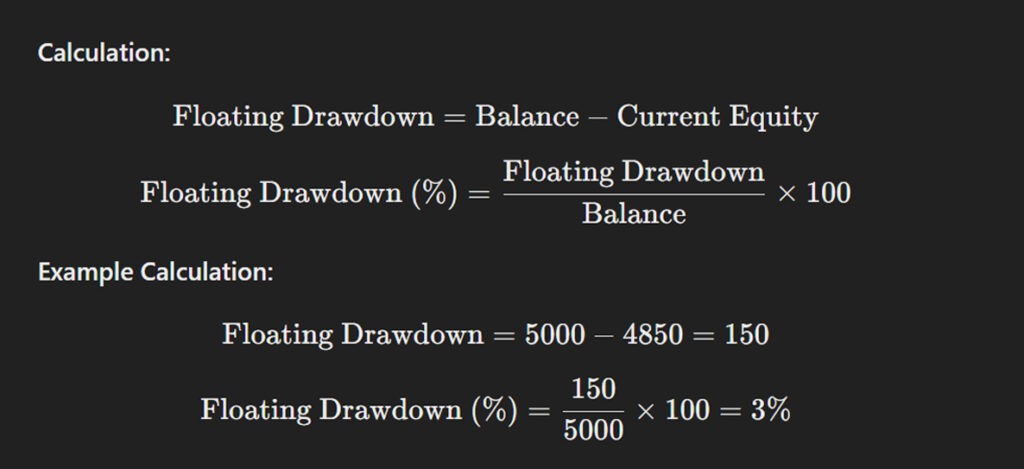
A floating drawdown, also known as a working drawdown, occurs when there are open trades that are currently in a losing position. It reflects the temporary reduction in equity due to unrealized losses.
Example of a Floating Drawdown:
- Initial balance: $5,000
- Buy 10 shares at $100 each.
- The price drops to $85, creating an unrealized loss of $15 per share or $150 in total.
- Balance remains $5,000, but equity decreases to $4,850.
Read this: A Comprehensive Guide to Hedging in Forex and Finance
Key Insight:
Floating losses are not final and may recover if the market moves in your favor. However, if a floating drawdown exceeds 50%, it may be a signal to reevaluate your trading strategy.
Read More: Top 10 Forex Trading Strategies for Consistent Profits
2. Fixed (Permanent) Drawdown
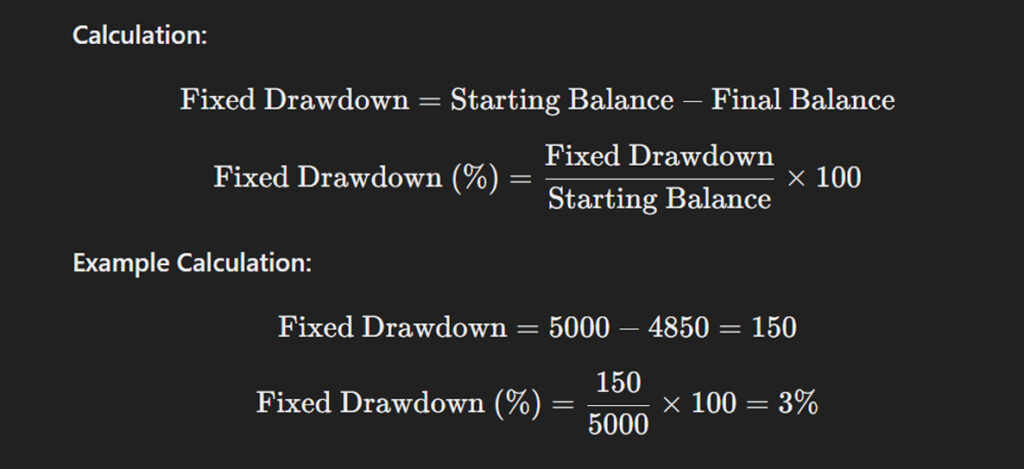
A fixed drawdown occurs when unrealized losses are finalized as actual losses. This happens when you close a trade at a loss.
Example of a Fixed Drawdown:
- Initial balance: $5,000
- Buy 10 shares at $100 each.
- Price drops to $85, resulting in a $150 loss.
- You sell the shares to prevent further losses.
Check it out: Best Forex Screener with Essential Tools for Successful Trading
Key Insight:
Fixed drawdowns highlight the losses associated with closed trades and provide a clear metric for assessing the effectiveness of your strategy. Ideally, fixed drawdowns should remain below 20%.
3. Absolute (Basic) Drawdown
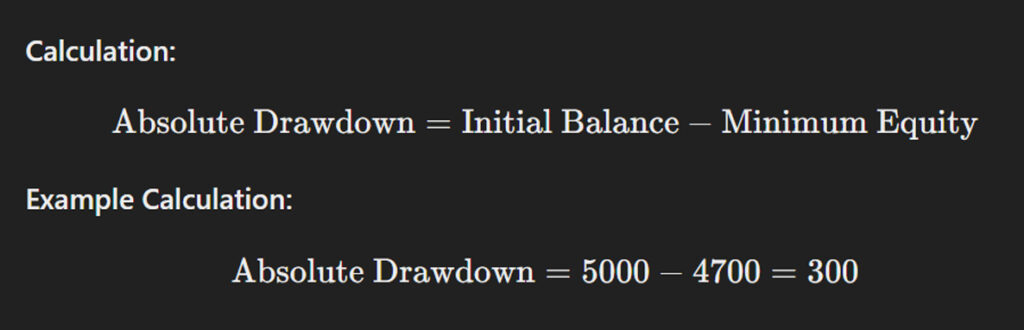
The absolute drawdown measures the difference between your initial deposit and the lowest equity point. It represents the maximum loss relative to the initial account balance.
Example of an Absolute Drawdown:
- Initial balance: $5,000
- Balance drops to $4,800.
- Equity falls further to $4,700 before recovering to $4,850.
Key Insight:
Absolute drawdown offers a benchmark for assessing the efficiency of your trading system. For most professional traders, it should not exceed 10% of the starting balance.
Discover More: 10 Proven Forex Risk Management Strategies 2025 to Protect Your Capital
4. Relative Drawdown
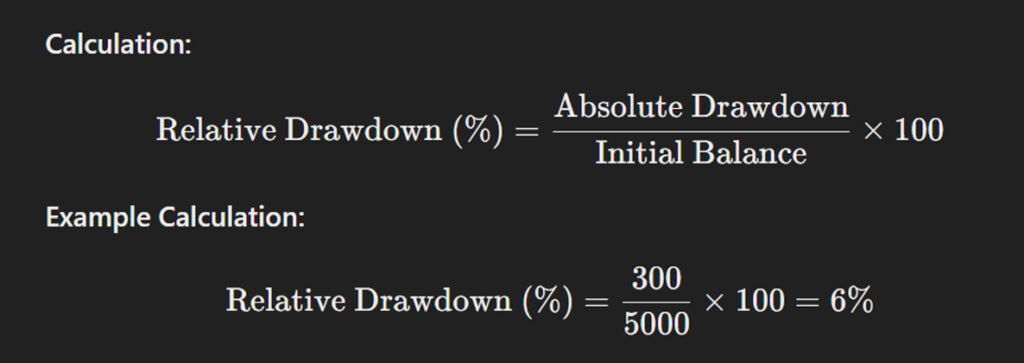
Relative drawdown expresses the absolute drawdown as a percentage of the initial balance. It’s widely used to evaluate trading strategies during testing and optimization.
Key Insight:
Relative drawdown helps traders set stop-loss levels and determine when to exit trades. It’s also used in investment strategies to assess the risk-return ratio.
Read more: FXonbit CandleStick Pattern Finder Service: Your Gateway to Smarter Forex and Crypto Trading
5. Maximum Drawdown
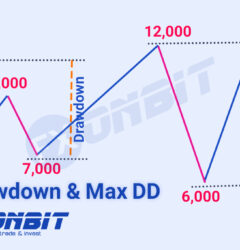
Maximum drawdown (MDD) measures the largest drop from a peak to a trough in account equity before reaching a new peak. It provides a clear picture of the worst-case scenario for a trading strategy.
Example of a Maximum Drawdown:
- Starting balance: $5,000
- Balance rises to $6,000, then falls to $4,000, before recovering to $7,000.

Key Insight:
Maximum drawdown is a crucial metric for evaluating a trading system’s resilience. While drawdowns of 30-40% are common in high-risk strategies, prolonged maximum drawdowns may signal the need for adjustments.
Read more: What is advantages of FXonbit’s Forex Screener?
Drawdown and Trading Strategies
Your trading strategy determines the acceptable level of drawdown:
- Low-Risk Strategies:
Allow a drawdown of up to 15%, focusing on steady growth and minimal risk. - Balanced Strategies:
Tolerate drawdowns between 20% and 35%, balancing risk and reward. - High-Risk Strategies:
Drawdowns can reach 50% or more, typically in aggressive trading systems like those using leverage or Martingale techniques.

Chart Pattern: Bump and Run Pattern: A Comprehensive Guide
Lessons from Drawdowns
- Assess Strategy Performance:
Drawdowns indicate whether your system is robust and sustainable. - Analyze Causes:
Evaluate if drawdowns result from market conditions, errors, or flaws in your plan. - Set Limits:
Define maximum acceptable drawdowns to prevent catastrophic losses.
Read more: Top Mistakes Traders Make in Forex Risk Management

How to Minimize Forex Drawdown
Even the best-prepared traders encounter drawdowns. Managing and reducing drawdowns effectively is a crucial part of trading success. Here are several strategies to help you minimize losses and regain control when your trades are not going as planned:
1. Close the Trade
The simplest way to reduce drawdowns is to exit the trade immediately.
- Why It Works:
Closing a losing position prevents further losses. It may not feel ideal, but the smallest loss is the one you stop from growing. If the drawdown surpasses your acceptable risk level and you’re unsure how to manage it, it’s better to cut your losses and exit. - Key Tip:
After closing, analyze what went wrong. Treat each new trade as a fresh opportunity and avoid letting the mistakes of the previous one influence your decisions.
Read more: Mastering Ichimoku Cloud Trade; Specialized Topics
2. Use a Trailing Stop
A trailing stop is an advanced tool to manage drawdowns without immediately exiting the trade.
- How It Works:
Unlike a regular stop-loss order, a trailing stop adjusts dynamically as the market moves in your favor. If the price reverses and hits the trailing stop level, the trade closes automatically, limiting the loss or locking in profit. - Why It’s Effective:
It allows you to follow price movements without emotional interference, offering protection if the trade starts to recover. For instance, if a position in drawdown begins to move favorably, the trailing stop reduces potential losses as it moves closer to the current price.
3. Hedge Your Position
Hedging is another way to manage drawdowns, involving opening an opposite trade to offset the current loss.
- How It Works:
- Open a trade in the opposite direction with the same position size.
- If your original trade is a loss, the new trade can generate profit, effectively “locking” the position while you strategize your next move.
- Example:
If you have a long (buy) position on EUR/USD and it starts losing value, you can open a short (sell) position for the same amount. This balances your exposure, halting further losses until you decide on a course of action. - Advanced Hedging:
- Same Instrument: Lock positions using the same currency pair.
- Different Instruments: Use correlated pairs. For example, hedge a EUR/USD loss with a USD/CHF gain, as these often move inversely.
- Why It’s Useful:
Hedging buys time to assess the market and avoid rash decisions. However, it requires careful planning and understanding of how hedged positions affect overall exposure.
Read more: A Comprehensive Guide to Forex Scanner
Key Takeaways for Reducing Drawdown
- Know When to Exit: Accepting a small loss early can prevent a larger one later.
- Utilize Automated Tools: Trailing stops provide a balance between risk control and profit potential.
- Strategic Hedging: When executed correctly, hedging offers flexibility and minimizes immediate losses.
Conclusion
Drawdowns are an inevitable part of trading, but understanding their types and implications can help you manage them effectively.
By setting clear drawdown limits and refining your strategies, you can minimize risk and improve your trading performance over time.
Remember, success in forex trading depends not just on profits but also on how well you manage losses.
Read more related: Drawdown and Maximum Drawdown in Forex

Related Article